Saturday, 11 April 2015

Rotorua and The Coromandel Pennisula


After our amazing visit to Orakei Korako, we arrived in Rotorua or more correctly in Blue Lake just outside of Rotorua. Rotorua is a major geothermic centre and with that comes a very strong sulphur smell. We had been warned by locals and other travellers to stay outside the city and just go in to do what we wanted. 

Rotorua planted trees from around the world in 1901 to see which trees would grow best in NZ. What happened is that they grew a rather fantastic Redwood forest with great walking trails.


That evening we attended a Maori feast and learned about their culture. 


Today we spent on Whangapoua and New Chum Beach on the Coromandel Peninsula. New Chum Beach has been voted one of the 20 most beautiful beaches in the world. We needed to wait for low tide on Whangapoua Beach and then hike around a point and over the saddle to reach New Chum. It was worth it. 


Wednesday, 8 April 2015

Taupo Area

After driving through the rolling farmland from Napier to Taupo we had a great hike to Huka Falls.  


However, the highlight of the last couple of days was the geothermic features. Craters of the Moon was our first introduction to geothermic activity in the Taupo area. It sits adjacent to the world's first Geothermic Power Station built in 1958. 


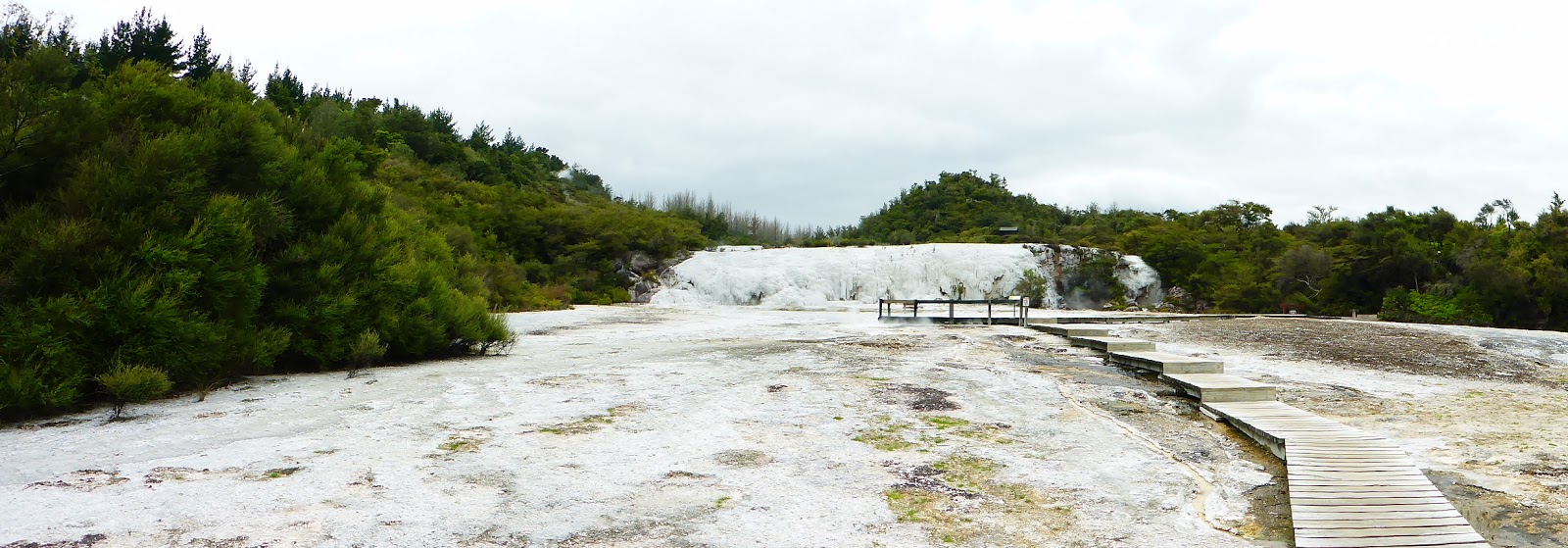
Rob and I are in the habit, when cooking in the communal kitchens, of asking fellow travellers and locals what sites are must sees. Rob met Karen from Wellington in Martinborough, who coincidentally is married to a University of Waterloo grad, and she said we must go to Orakei Korako. Orakei Korako is off the beaten track and not as popular as many other geothermal tourist attractions so we decided to go. In order to get close to the geysers and silica terraces we had to first take a short ferry ride over the lake. Once there we followed the boardwalk system and read the plaques explaining the history of each feature. We were amazed and captivated. It was spectacular and we spent most of the afternoon there.  We came away feeling very peaceful. 

In order to see the real impact of the photos, click to enlarge them. 


Monday, 6 April 2015

Napier - Art Deco Downtown

The 1931 earthquake, lasting an incredible 2 and 1/2 minutes, registering 7.8 on the Richter Scale, all but destroyed Napier.  The islanders joined together to rebuild their city over the next two years. The influence of art deco architectural design was evident throughout all the construction that took place. Our afternoon guided tour provided us with an enjoyable look at the history of the city and their continued emphasis to retain this architecture today.


Tuesday, 31 March 2015

The most beautiful hike we have ever done...so far

Today's post will be short and sweet because we are wonderfully tired and nothing sounds better than a glass of wine on the beach. We hiked 18 km in the Abel Tasman National Park from Wainui Bay to Separation Point. It was spectacular - lots of up and down, amazing view points, great forest and we saw absolutely no one until the late afternoon hikers were coming into the park to stay over night at the Whariwharangi Hut.


Happy Easter everyone!

Golden Bay - kayaking and tramping

We arrived in Pohara, Golden Bay on Sunday night and are staying for 4 days at our ocean side campsite. Monday, after yoga on the beach under the most beautiful sunny sky, we headed out to Tata Beach to kayak with Golden Bay Kayak.  Our trip took us to the edge of Abel Tasman National Park in Wainui Bay. We were just two of 4 people with our guide Paul. The tandem kayaks handled beautifully on the perfectly calm waters. Roblin (I ) was very thrilled by this!  


Hot chocolate on the beach with our guide Paul and Alex from Italy with his girlfriend, Isabelle from New Caledonia. 

Tuesday morning we woke up to another beautiful day and decided to go up to Farewell Spit at the most northern edge of the South Island. The Farewell Spit is a nature reserve with incredible sand dunes that divide the top edge of the island, with Golden Bay on one side and the Pacific on the other. We hiked up the Golden Bay side, cut across the spit to the Pacific side to be greeted by the most fabulous stretch of untouched beach that stretches for 35 kms. 


The route for the tramp back was over the dunes and through farmers' fields.


On our return down the coast we stopped at Estuary Arts where we spent time talking to the resident artists, Bruce Hamlin and his wife, Rosie Little. We purchased a piece of art of the Farewell Spit that will always remind us of our holiday. 


Our day ended with a trip to the Waikoropupu Springs - a sacred Maori site with the clearest water in the South Island. 


Sunday, 29 March 2015

World of Wearable Art in Nelson

After spending the morning at the Nelson Farmers' Market we went to the World of Wearable Art Museum. This was the most enjoyable 2 hours at a Museum that we can remember. The exhibits of garments, created by international artists, to be worn in a Cirque du Soleil - like show were incredible. We loved it. If you get a chance Google the WOW Museum.


A dress made entirely of balloons.


This entry was in the Bizarre Bra category - made with spent bullet casings with one being the poppy. 


The Farmer's Daughter's Dress, complete with Wellys.

Westport and Charleston Adventures

We have had such a great time over the last few days. On Thursday we stayed in Westport, on the Northwest coast and spent the morning watching the seals at Cape Foulwind. The colony is out on a point and the viewing area is a lovely walkway that is perched above the seals. You can stand there all day and watch the seals in their natural environment. We were lucky enough to see a few mother seals nursing their babies.  Here is one of a seal looking like he is ready to perform for the circus.


The beach on the way down from Cape Foulwind was a school group playing the national game, Cricket. 


In the afternoon we went to join the Underworld Adventures Tours of the Charleston caves. The tour was 4 hours of exploration of the cave system discovered in 1960. We covered over 1.5 km underground, with the final .5 km floating on an inner tube marvelling at the glowworms' luminescence. It was magical! 


One of the features that we were able to see up close were the drapes - formed over years by the constant leeching of water through the limestone.